
Thomas Elyngbrigge
- Date of Brass:
- 1497
- Place:
- Carshalton
- County:
- Surrey
- Country:
- Number:
- IV
- Style:
- London D
Description
October 2026
Brasses have been lost over the centuries in various ways. The religious changes of the years after the Reformation were a major cause. Another was the high value of the metal, which resulted in much re-use as plates were turned over and cut up, leaving jigsaws of re-used pieces spread between different churches in different places that are still coming to light. Earlier than that, some religious establishments closed for various reasons or cleared old slabs from their floors to make room for new ones.
The Civil War and Commonwealth resulted in the removal of ‘objectionable’ brasses, both in part or completely, where the Reformation had missed them. The development in the Elizabethan period of a native industry which made the metal from ores mined in England had meant that brass was much less valuable; some of the fragments of metal removed in the 1640s were simply thrown away, and not recycled. The eighteenth century was a period of neglect, resulting in further losses as church buildings deteriorated.
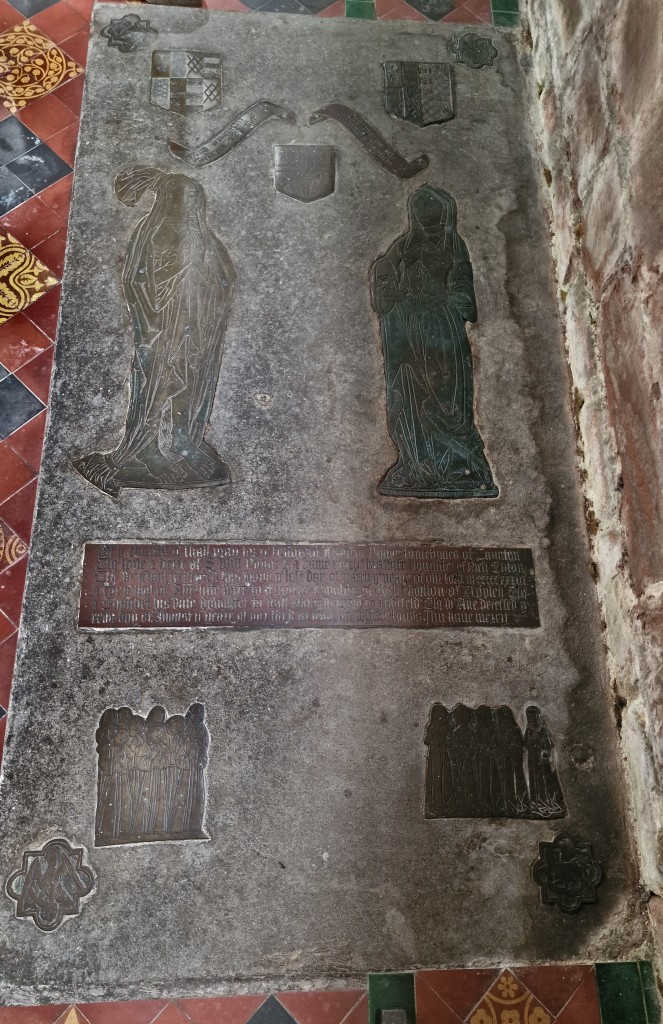
The nineteenth century saw neglect replaced with interest and rebuilding, but lack of supervision during building work often led to further losses. A case in point is the brass of Thomas Elyngbrigge at Carshalton. His brass was largely complete when it was rubbed by J G Waller on 30 July 1837, missing only the lower parts of the canopy, two groups of children (three sons and two daughters), a shield and most of its foot inscription. More, if not all, of the inscription had been recorded by D T Powell in 1806, but the fullest transcription was by Nicholas Charles, Lancaster Herald, who died in 1613.
The losses since Waller's rubbing are believed to have occurred during building work later in 1837, so Waller’s visit was fortuitously well timed. The parts of the brass lost at this time are indicated on Mill Stephenson’s illustration, originally published in 1913. The upper half of Thomas’s figure and the fragment of the inscription were also lost at this time, but rediscovered during the major rebuilding of the church in 1895 and relaid.
Thomas Elyngbrigge esquire died on 22 May 1497. His inscription described him as a justice of the peace for Surrey and a gentleman usher of Cardinal Thomas Morton, Archbishop of Canterbury and Chancellor of England. It also named his wife as Elizabeth. Her parents were Nicholas and Margaret Gaynesford, whose brass is further to the east, on the back plate of a Purbeck marble tomb chest that once served as a base for the Easter sepulchre.
Both Thomas and Elizabeth died within the lifetimes of her parents, who had already had their brass made. Thomas wanted to be buried in the church near the place where Elizabeth lay. His executors (his sister Joan and her husband Henry Burton) evidently chose a design by the same London marbler as had designed the Gaynesford brass, but their effigies are recumbent rather than kneeling. The inscription in three lines reads:
Hic iacet Thos Elyngbrigge ar’ quonda' un’ justiciar’ pacis infr' com' Surr’ ac hostiar’ generos’ cu' reverendissimo in xpo patr’ + dno John Morton cardinal’ archiep’o Cantuar’ + cancellar’ Angl’ Nec non Elizabeth ux’ eius qui quidem Thoms obiit xxii die Maii Ao dni mo ccccolxxxxvii quorum aiabs ppicietuur deus Amen.
The Gaynesford brass has lost its image of the Trinity. This may have been due to iconoclasm during either the Reformation or the 1640s. If so, the rarer but equally ‘objectionable’ image of Our Lady of Pity on this Elyngbrigge brass was missed. It is one of only three surviving examples, the others both being from brasses of the 1530s, in St Patrick’s cathedral, Dublin, and in All Hallows Barking in the City of London.
Copyright: Jon Bayliss (text and photo)

- © Monumental Brass Society (MBS) 2026
- Registered Charity No. 214336