
Richard Verney
- Date of Brass:
- 1526
- Place:
- Compton Verney
- County:
- Warwickshire
- Country:
- Number:
- II
- Style:
- Coventry 3
Description
April 2026
The three series of brasses engraved in the Midlands, probably at Coventry, during the late fifteenth and early sixteenth centuries, are well known; this in part because of the very idiosyncratic style of the figures. Indeed, the late Malcolm Norris referred to the strangely grinning faces of the First Series which make them and their successors instantly recognisable. Most of the brasses commissioned from this workshop would come to be laid down in churches within the counties of Leicestershire, Northamptonshire, Shropshire, and Warwickshire.
Two of the best surviving examples of the Third Series are to be found in the eighteenth-century chapel at Compton Verney in Warwickshire. The earlier of the two, dated 1523 and commemorating Anne Odyngsele, has already been the subject of a piece in the Society’s Portfolio of Plates.
The second commemorates Richard Verney esquire (died 1527) his wife Anne, and their fourteen children - nine sons and five daughters. One of their daughters was the Anne referred to above, who married Edward Odyngsele of Long Itchington, Warwickshire.
Anne was left a widow in 1522 and predeceased her father in 1523. Her husband was once commemorated in Long Itchington church by a brass inscription which, given its date and the subsequent patronage of the same workshop, is very likely to have been a Coventry product.
Both the Compton Verney brasses have been re-laid on the south side of the altar on the floor of the new chapel; this building having been erected between 1776 and 1779 to a design drawn up by none other than the landscape architect, Lancelot “Capability” Brown. The chapel replaced the original medieval church at Compton Verney, demolished when the house was rebuilt and the park landscaped in the eighteenth century.
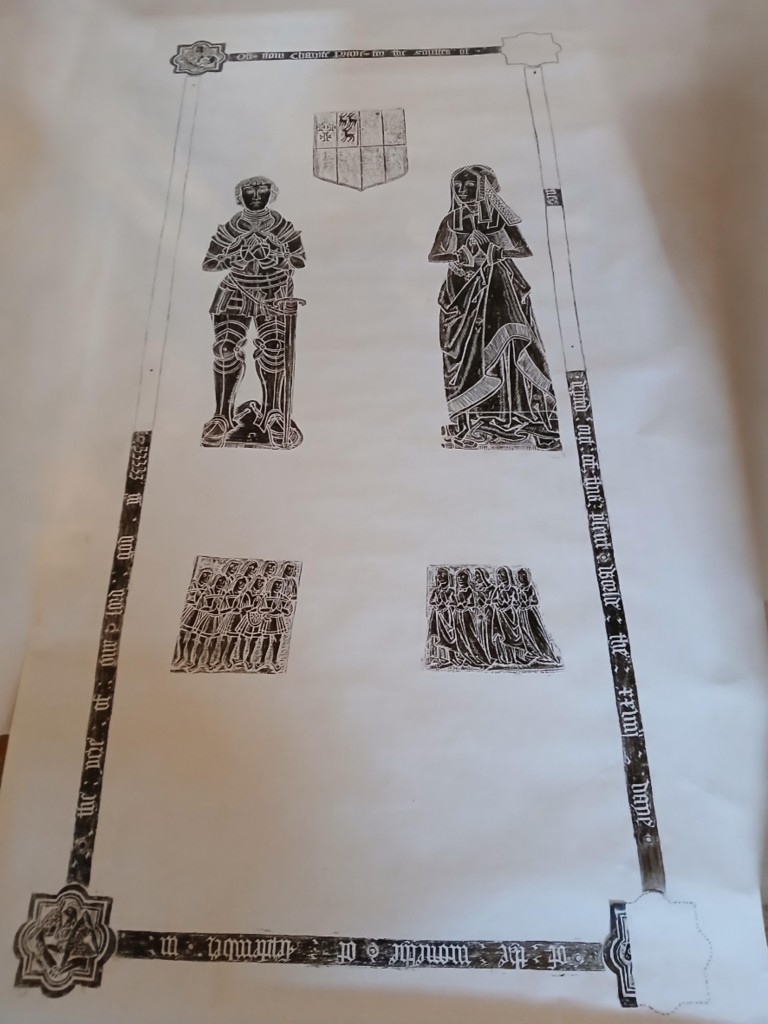
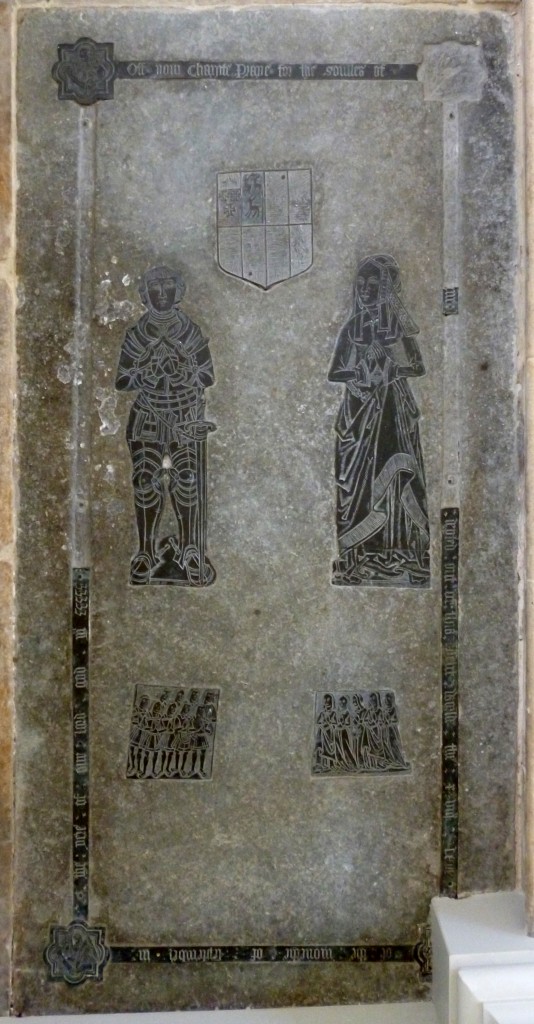
The main figures on the memorial are typical examples of the Third Series of Coventry brasses with their almost comical faces, the figures dumpy in appearance, the man’s hair being portrayed as roughly curled, the armour fanciful, and the lady’s richly furred over gown caught up at the front.
The parents and their children are surrounded by a marginal inscription rendered in English, in Black Letter script, and with symbols of the four evangelists placed at the corners. Of these, St. Matthew is now lost and that of St. Luke mostly covered by part of the altar platform, while St. Mark and St. John remain intact and wholly visible.
There is also a large shield, placed centrally above the two main figures, emblazoned with the arms of Verney arg, three crosses moline, or voided gu, a chief vairy erm and ermines impaling Danvers arg on a bend gu three martlets or quartering Pury arg on a fess az between three martlets sa three pierced mullets arg. Danvers is for the marriage of Richard Verney and Anne Danvers (see below) while Pury commemorates the marriage of Sir William Danvers and Anne Pury of Crookham, Berkshire - the parents of Anne who married Richard Verney.
The heraldry on the shield is now largely illegible but is shown to rather better effect in a sketch of the brass made by Sir William Dugdale (1605-1686) the seventeenth century antiquary and reproduced in his Antiquities of Warwickshire published in 1656.
Most of the marginal inscription has survived and reads:-
Off your charite pray for the soules of/ [Richard Verney esquier and An]ne [his wife which Richard] dep(ar)ted out of this p(re)sent world the xxviii daye/ of the monethe of september in/ the yere of our lord god MCCCCC ......
The parts enclosed in square brackets are now lost – but see below.
The brass was originally in the North Chapel of the old church at Compton Verney; Richard Verney in his will, made on the 2nd October 1526, requested that he be buried in the new chapel in the north side of the parish church of Compton Verney.
All the surviving brasses, together with several of the other monuments and stained glass then in the original church, were sketched by Dugdale but it should be noted that his transcription of the content of the inscription of the brass under consideration, when compared with what still survives, is incorrect.
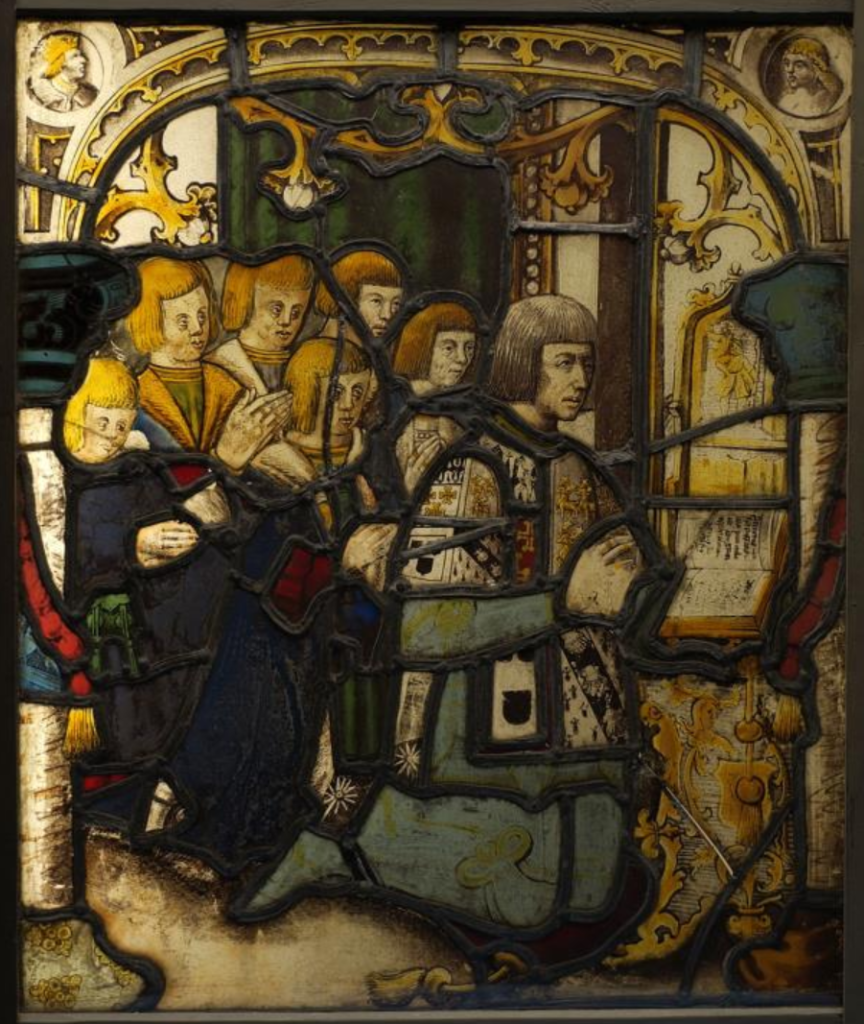
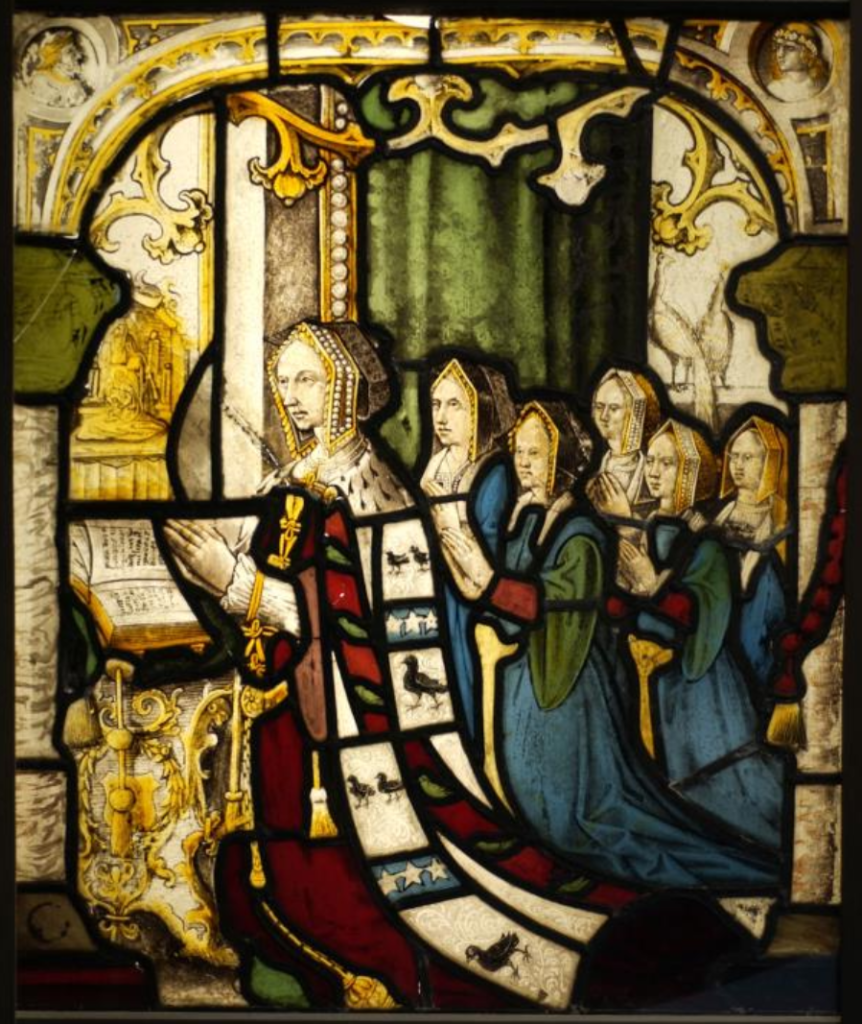
In 1929, two panels of magnificent sixteenth century-stained glass from the original church, depicting Richard and Anne Verney and their children, were sold by the then owner of the Compton Verney estate. Since 1954 these have formed part of the collections of Warwick Museum. However, they are not presently on public display; the author is very grateful to the museum authorities for permission to view them.
Richard Verney was born in 1464, the year of his birth being established from the Inquisition Post Mortem taken following the death of his father Edmund in 1494, when Richard was said to have been aged 30. In 1517 Richard was granted an unusual dispensation by Henry VIII - that of being allowed to always wear his cap, including in the king’s presence, on account of a problem with his head - presumably some scalp affliction. John Forester of Watling Street, Shropshire, another of those waiting on the king, was given a similar licence. Both men, duly sporting their caps, may be seen in attendance on Henry VIII in the well-known painting dated to c.1545, showing the king at the Field of the Cloth of Gold in 1520.
Richard Verney married Anne Danvers a daughter of Sir William Danvers (1428-1504) Serjeant-at-Law and a Justice of the Common Pleas; the couple would have a large family. However, by the time of Richard’s death, it is more than likely that some of the children on the brass were long dead as only three sons, Thomas (his father’s heir), George, and John are referred to in Richard’s will. To reinforce this presumption but six of the nine sons appear in the near contemporary stained glass. However, all five of the girls on the brass are also shown in the panel depicting their mother.
Anne Odyngsele is also mentioned in her father’s will but only regarding property which she had previously bequeathed to her mother with whom it was to remain and that mine (Richard’s) executors have no meddling nor interest therein. Anne Verney herself would survive her husband by over thirty years, dying in 1558.
The author is also most grateful to the Management Committee of the Compton Verney estate for exceptional permission to rub the two surviving sixteenth century brasses in the chapel on 19th March 2026.
© Jonathan Moor LL.B.(Hons.)BA(Hons.) 2026
Glass: Creative Commons
Photo of brass: Jon Bayliss
- © Monumental Brass Society (MBS) 2026
- Registered Charity No. 214336