
George Hatteclyff
- Date of Brass:
- 1514
- Place:
- Lewisham
- County:
- Kent (now London)
- Country:
- Number:
- I
- Style:
- London
Description
January 2026
The church of St Mary in Lewisham was formerly in Kent but is now well inside the boundaries of London. Its fifteenth-century tower is the oldest building in the locality, but the rest of the church was pulled down in 1774 and replaced by a Georgian structure with galleries designed to cater for a growing population. The monuments from the old church were initially stored in the almshouses opposite but only a few were then placed back in the new church. Such rebuildings were a major cause of losses of monumental brasses and other memorials.
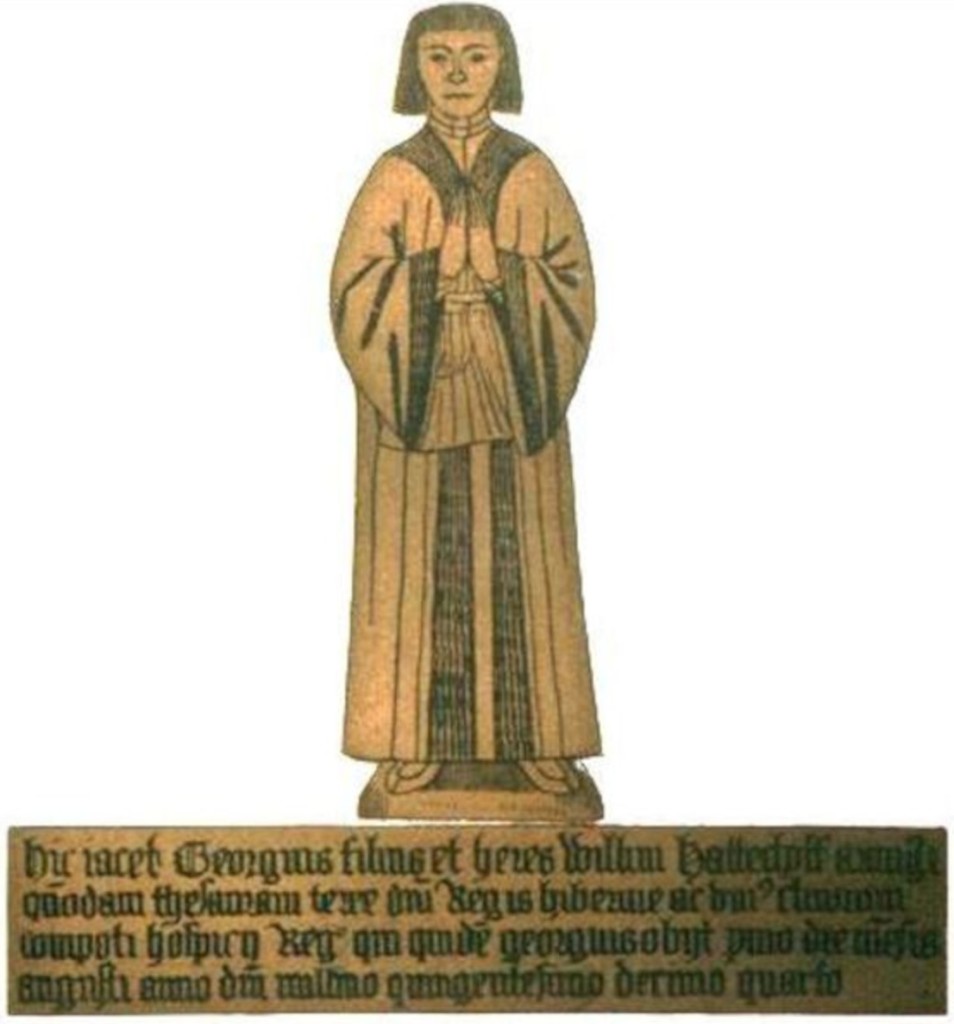
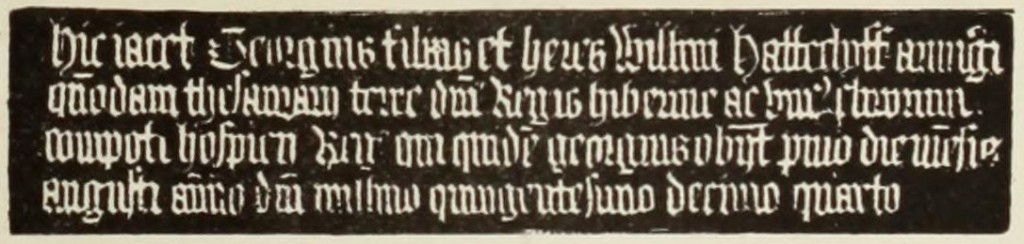
Amongst the survivors is just the inscription from the brass of George Hatteclyff or Hatcliffe. This was recorded and illustrated by John Thorpe in his Custumale Roffense (1788), from observations made before 1774, and was described in the following manner:
On another gravestone within the rails is the effigy of a man in brass, with this inscription in black letter:
Hic jacet Georgius, filius et heres Willielmi HATTECLYFF, armigeri, quondam thesaurarij terre domini regis Hibernie, ac unius clericorum compoti hospicij regis; qui quidem Georgius obijt primo die mensis Augusti, anno domini millesimo quingentesimo decimo quarto.
Above was an escutcheon of brass, now defaced; beneath the plate were two escutcheons; the first is gone, but the second remains in part blank, impaling 3 fleurs-de-lis, a label of 3 points.
The partial second coat of arms described above matches neither Hatcliffe nor Leigh.
The illustration of George Hatteclyff's brass is derived from Thorpe. It was included in a later parish history, L L Duncan's The parish church of St Mary Lewisham, Kent; its building and rebuilding (1892). Duncan's illustration can be seen online within the Lewisham parish website, https://midd.me/vDfR There it is accompanied by a modern rubbing of the brass inscription.
George’s father was William Hatcliffe of Lewisham. TM Hofmann, writing for the website of The History of Parliament, identifies William as MP for Great Grimsby in 1515, close to his ancestral seat at Hatcliffe, and notes that ‘extant pedigrees are erroneous and contradictory’, making it difficult to identify him for certain among contemporaries of the same name. William was an important royal official, as indicated on his son's brass inscription: Treasurer for Ireland and 'one of the clerks of the account of the royal household', that is, a Clerk of the Green Cloth. He followed his father and grandfather into royal service, and was closely associated with Thomas Wolsey during the latter’s rise to power. He entertained the papal legate Campeggio at his house in Catford in 1518.
The name of George Hatteclyff's mother is not known. After her death, William Hatcliffe remarried to Isabel Hervey, widow of John Legh of Addington, Surrey, after her subsequent short marriage to Roger Fitz. She already had a son, Nicholas, and a daughter, Anne, by John Leigh. She was therefore George’s stepmother. (There is no indication on the brass that George was a child when he died, less than ten years after William and Isabel’s marriage, and the purse hanging from his belt is indicative of an adult.)
William died early in 1519, only five years after his son. He willed to be buried at St Mary at Hill in the City of London. He left bequests to two brothers, Thomas, who succeeded him as a Clerk of the Green Cloth, and George, presumably the London mercer of that name, and also to his stepdaughter Anne Leigh and stepson Nicholas Leigh. Anne Leigh later married William’s brother Thomas. Thomas survived until 1540 and was buried at Addington. His brass shows him in armour.
Copyright: Jon Bayliss, text & photo

- © Monumental Brass Society (MBS) 2026
- Registered Charity No. 214336